Here's what the pruce looks like now Tom. Keeping my fingers crossed that it survives the trauma of Kamikazi Bonsai. I'll keep you posted.
Tuesday, July 27, 2010
Update on spruce II
Here's what the pruce looks like now Tom. Keeping my fingers crossed that it survives the trauma of Kamikazi Bonsai. I'll keep you posted.
Friday, July 23, 2010
Update on spruce.
Sunday, July 11, 2010
Photos from July 10th Workshop
CHARLES LARKE AND MAC MCMULLEN WORKING ON CHARLES' NEW SPRUCE
JOHN GRISAFI WORKING ON ONE OF HIS FICUS AND HE BROUGHT AN EXCELLENT HEDGE MAPLE
STAN AND JOAN KARP WITH SOME OF THEIR JUNIPER PROCUMBENS
JAY BURTON & YETTA BERGMAN WITH SOME OF JAY'S GREAT NERIFOLIA
TOM, MY APOLOGIES FOR THE BLURRED PHOTO BUT I WANTED TO SHOW YOUR EXCELLENT TREE.
FIGS ON TOM & CONNIE KRUEGLS' REALLY NICE FICUS
July 10th, Morning Workshop
July Workshop.
Had a nice turnout of about 15 people for our July Workshop at Clover Garden Center, even though we did not have a Reporter or Photographer from the Courier Post.
Fairly cool and rainy morning with some nice trees to work on and a lot of the usual conversation, advice, ifs, ands and buts, offerings of opinions, etc.
Charles Larke has a new spruce to work on aided by Mac McMullen.
John Grisafi worked on one of his small ficus and brought in a large hedge maple.
Joan & Stan Karp were opening up and trimming some of their juniper procumbent.
Jay Burton and Yetta Bergman were talking about the finer points of his fine ficus necrophilia
Tom & Connie Krugel brought in a wonderful ficus which had hundreds of little, but inedible figs on it. Really neat.
These workshops are a great place to have fun, do some needed work on your trees and share a lot of good information and stories.
August’s meeting will be in the evening, at Clover Garden Center, Wednesday, August 11th, 7PM to 9PM, to work on trees and discuss upcoming activities of the club.
Hope to see you then.
Tom De Simone
President
Bonsai Society of South Jersey
Friday, July 2, 2010
July 2010
Good Afternoon Bonsai Enthusiasts.
Happy July!!!!! Hope your bonsai are thriving even with the protracted heat wave we just had AND REMEMBER, this weekend is predicted to be very hot at 95+ on Sunday and Monday so be sure to water thoroughly, morning and evening if possible but at least once for sure.
Our monthly meeting will be a workshop at Clover Garden Center on Saturday, July 10th from 9AM to 1PM. This is an excellent time to work on any tropicals you might have or to wire up any conifer or deciduous trees.
This article was forwarded to me by Carl Rosner of Margate, NJ. Just for increasing your knowledge of bonsai and gardening in general.
Dear Gardening Friends, 
Not all insects are pests. Some actually make perfect pets for the gardener! They will not damage plants, only the insects that damage plants. This bio-control is known as Integrated Pest Management, and beneficial insects are an important component.
We can make our gardens friendly to their habitats such as planting perennials that provide a place to lay eggs and give shelter - yarrow, fennel, daisy, baby's breath, parsley and many others. Allowing for a grass path will provide a home for ground beetles, and a birdbath or water feature with a perch of rock or stick will help keep them around during dry weather.
What you want to create is the proper balance by increasing the numbers of
predators to prey and use only organic and nontoxic garden products like insecticidal soaps and sticky traps. Don't wait for a pest problem to be out of control. Plan for your good bugs to the rescue before the potential problem occurs!
Typically, Ladybugs eat over 5,000 Aphids and other soft-bodied pests during their one year life. Ladybugs are one of the few beneficial insects that can be stored, dormant, in the refrigerator for a few weeks, as long as they don't freeze or dry out. This allows you to use a few at a time, as needed.
Tiny Whitefly Parasites lay their eggs inside Whitefly pupae, so a Whitefly Parasite hatches instead of a Whitefly. You'll need a magnifier to see them, but they spell death for greenhouse Whiteflies.
Predatory Mites feed on Spider Mites and their eggs, they also breed twice as fast! Each Spider Mite Predator sucks the juice out of about 5 Spider Mites a day, or 20 of their eggs. Predators disappear when the Spider Mites are gone.
Aphid Predators have worked so well in many greenhouses, that, by summer, Aphids may be hard to even find. Breeding populations of predators are usually established from a single release, but regular weekly releases during the growing season speeds up control.
Green Lacewing larvae look like tiny "alligators", and voraciously attack almost any prey they can grab, using pincer-like jaws. After injecting a paralyzing venom, they suck the body fluids from their helpless victim.
Praying Mantis are not only fun garden pets, but they eat anything and everything they can catch! Praying Mantis constantly entertain while they eat insects all summer long.
Create a favorable home for your Beneficials ahead of time…
Reminder-- Beneficial Insects don't tolerate most pesticides very well, so it's very important not to apply residual pesticides (such as Malathion and Sevin) for at least a month before releasing your beneficials. While you're waiting out this month period, use soapy water sprays (such as Safers) or Sticky Traps right up to the day you let out the beneficials. Also botanical sprays (derived from Pyrethrum and Rotenone, for example) can be used with a one week wait afterwards. The small amount of time you spend creating more favorable conditions for Beneficial Insects will be well worth your while!
Let the Good Bugs clean up your pests and have fun watching them! 
Until next time,

Alias Mrs. Charley
Wednesday, June 16, 2010
Ski Dombrowski's Salem, NJ Visit
Wednesday, 6/16, Karen Harkaway, Mac McMullen, Charles Larke and I drove down and visited "Ski" Dombrowski at his bonsai center in Salem, NJ. Some might remember "Ski" visiting us this past winter. He is a member of the Chadds Ford Bonsai Club, is retired and sells his bonsai, teaches people personally and provides presentations and demonstrations. We will have him give a demonstration at a future Saturday morning workshop.
The costs for his trees are very reasonable. He has been involved in bonsai for more than 35 years and really knows his stuff. We bought a couple of trees and will be going down to purchase a couple of more. It takes about 1 hour and 15 minutes to get there but the directions are simple.
I'll let the membership know when we are going back if you would like to join us. He has both developed bonsai and pre-bonsai material. This is a very unique place and a very unique bonsai artist.
Tom De Simone
Tuesday: Kunio Kobayashi: Proper Formal Bonsai Displays
Today was much more relaxing than the last 4! Spent the day going over the finest details of setting up a formal Japanese Bonsai display.
Mr. Kobayashi went over the history of the Keido School of Display, so we had a proper understanding of how these things evolved. Mr. Katayama, who started the school, had Mr. Kobayashi and Mr. Sudo as his final best students, and wrote a set of 3 books on proper displays just before he died.
Mr. Kobayashi has continued advanced studies on this fine art, and is now still just starting to understand some of the finer details his teacher gave to him.
We covered scrolls, their making and composition, and what the differences between 'formal', 'semi-formal', and 'informal'. These classifications apply to virtually everything in the display, so control how things are combined and presented.
We learned about accents, and how they can act as a 'stop' to the flow of energy presented by the bonsai being displayed.
Mr. Kobayashi covered display stands, and how they can add to, or detract from a nice tree-pot combo. Size, height, color, etc. all play their parts.
We discussed seasons and geography, which must be considered when putting the display together.
The objective of the display is to make the viewer 'see' what the artist sees, so the viewer can envision streams in lowlands, or high mountains, with birds soaring, winds blowing, and powerful aged pines clinging to life on a narrow rock outcropping.
Mr. Kobayashi put together a wonderful winter display...when he was finished, I actually felt a bit of a shiver go up my spine!
We had lunch, and in the afternoon formed groups to apply the rules Mr. Kobayashi had given us. We used Bill Valavanis' personal bonsai, stands, scrolls, and accents to set up displays for our groups. These were in turn judged by Mr. Kobayashi, and so we received good feedback on what we had done.
Of course, Bill got his trees cleaned up by each group, as one of the 1st things to do before a display.
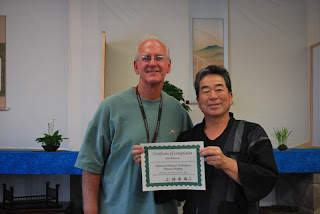
Finished up around 4:30 PM, and each person received a Certificate from Mr. Kobayashi.
This wonderful bonsai master is a kind gentle spirit who exemplifies the spirit of Bonsai, and I personally have been changed for the better by having met and studied under him.
Flex
Post-Show:
Photos:
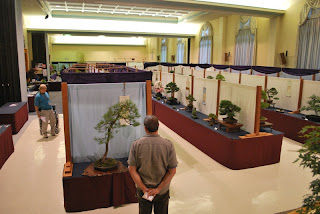
...and Bill DID allow me to take "a few" personal shots of the show. In particular I was interested in the accents, which I mentioned were spectacular.
The photo album he publishes will be available in the November timeframe.
Tree Quality:
I had the pleasure of visiting the Ginkgo Festival in Belgium in 2005, which was the 5th of the series. In looking at "The Best of Bonsai in Europe", starting from 1 and going forward, the trees got much better each successive show. By the 5th they were, in some cases, real mind-blowers!
Looked over the 1st album from the 1st US Exhibition 2 years ago, and the trees this year are following the same trend as Ginkgo did, so perhaps the US bonsai community is starting to realize that we too can build some impressive trees!
Flex
Subscribe to:
Posts (Atom)