Monday, May 9, 2011

Washington DC Show


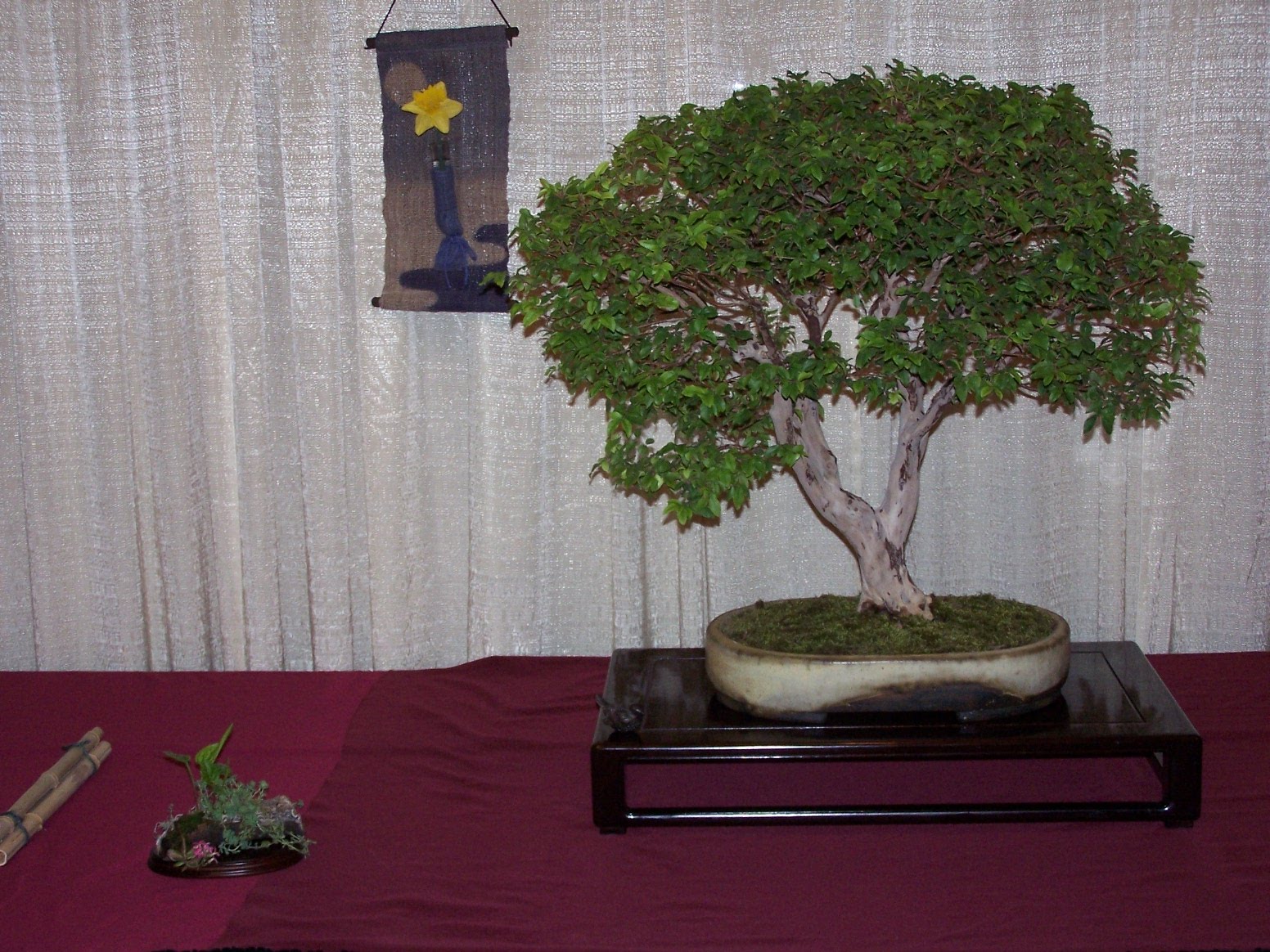
I drove down to Washington, DC Saturday to support and assist Chase Rosade who was giving a critique and then a demonstration for the Potomac Bonsai Society at the National Arboretum.

In the morning, Chase was critiquing club trees which were on display and then in the afternoon, he worked on repotting and redesigning a famous Juniper from John Naka which was given to him 7 years ago in very poor condition. He (I should say the anonymous owner) is donating it to the Arboretum.

George (Mac) McMillen was also there and took photos which I am waiting for. Anyway, here are some photos of some of the trees and Chase with the Naka tree.

Sunday, April 24, 2011

Ah, the colors of Spring!

Kwanzan Cherry


Pink Dogwood


Air layer from last Spring Japanese Maple


Saturday, April 23, 2011

Whitesbog Followup: Blooming Blueberries

The Blueberry trees collected from Whitesbog are now blooming, and pushing out loads of new growth, so thought would share.

These blooms are small, only about 1/4 inch long, and hang in clusters out on the branches. Their fresh whitish color is in stark contrast to the rough craggy bark, which has formed even out on the branches.


Local bees have been visiting, so there is some chance of local fertilization, and maybe some berries will form later in the season.


I enjoy the delicacy of these small fine blossoms...I hope you do also!

Happy Easter!

Flex

Sunday, April 17, 2011

Whitesbog: Collected Blueberries Bustin Blooms!

Have all collected Whitesbog blueberries in mostly shade since collecting. With all the rain past few days, the trees have responded like real bog warriors, and blooms & buds are pushing out all over.

Flex


This one is a tall very twisted trunk beauty, which will make a very nice literati.


...and here are the buds:


One of two 60 to 80 year old trees, beaten & eaten down by animals & Mother Nature...very sweet:


Will post more when these are out in bloom...
Flex

Mid-Atlantic Conference, Hershey, PA 2011

Don Lem and I drove up to Hershey yesterday in the pouring rain and had a very good time. The members who attended were myself, Don Lem, Karen Harkaway, Flex Houvig, Doc Stone, Alec Pettifer and George McMullen plus Chase Rosade. I photographed all of the display trees and here are some from the show. I believe the second photo is of Karen Harkaway's tree and the last two tree photos are Solita Rosade's and Chase Rosade's respectively. The last photo is some of our folks at the show but I never got a change to get everyone together. Mid-Atlantic is interested in having us join their organization. More on that later.


Sunday, April 10, 2011

BSSJ: Air Layering Demo


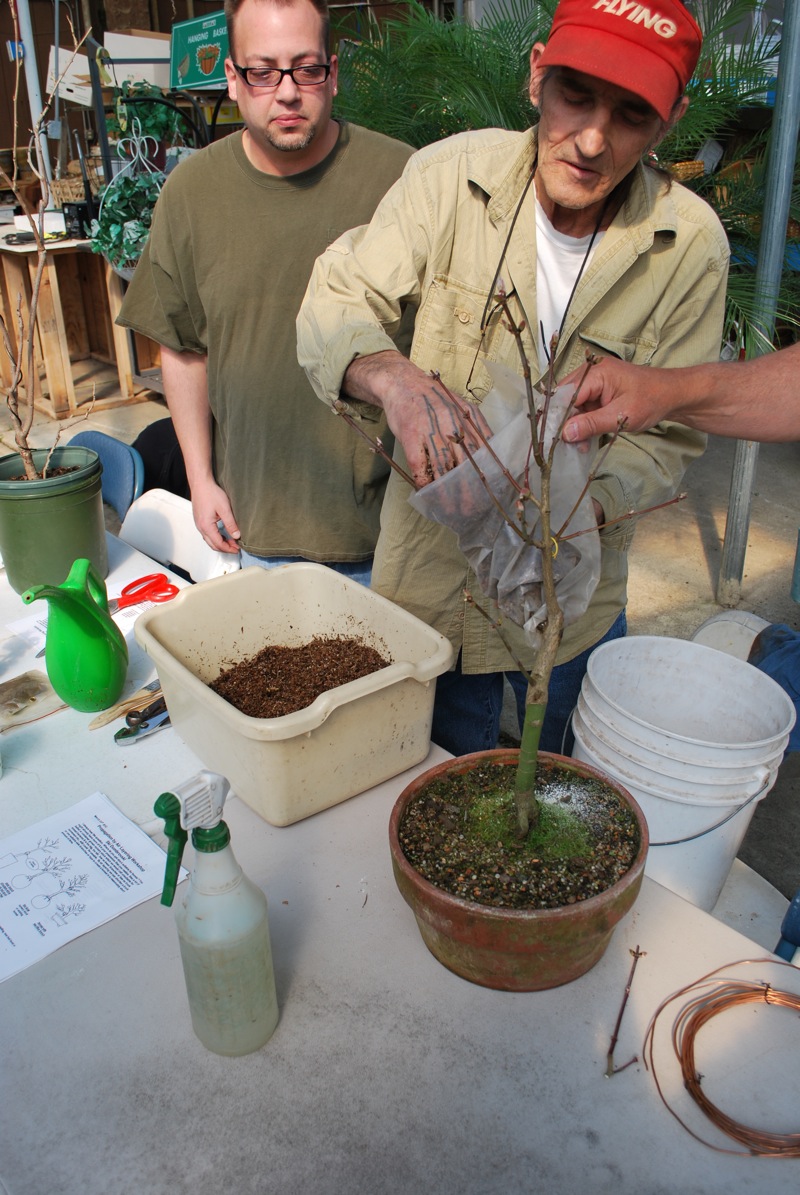
Saturday at at Clover Gardens, Marlton N.J., Ski Dombrowski explained and demonstrated the air layering technique he has used successfully for many years, to BSSJ club members.

Ski used a Full Moon Maple as his subject.

Technique:

The right-hand branch was selected to layer off. Ski used a large-diameter copper wire to form a tourniquet around the base of the branch, placed at the point where he wants roots to form. The roots will come out just above the wire.
When applying the wire, it is tightened with pliers until 1/2 of the diameter "crushes" the cambium. Ski explained that smaller diameter wire will cut the cambium, which will likely kill the branch, hence the use of larger diameter wire.

Once the wire tourniquet has been placed, several "nicks" should be made into the cambium, above the wire. This helps the tree to absorb the rooting hormone easily. The nicks and branch are wetted with sprayed water. The rooting hormone is picked up using a small brush, and "flicked" onto the wetted area. Moistened clay is then placed over and around the hormoned area, to hold hormone in place.


Ski then measured the length of the branch where roots need to be: 2 inches. He then sized the plastic covering which is applied next: length = 5 X (length to have roots) = 10 inches. Width of the plastic is 1/2 of that, so the resultant plastic sheet is 5X10 inches.
The plastic sheet was cut, and a "bag" formed. This was fitted down over the branch, and gathered at the branch base, below the wire. This gathered section is then tied using strong string (which has a little "give", like multi-strand fishing line).
Ski then poured a mixture of sphagnum moss and soil mix into the bag, and tamped it firmly into place. When full, the bag was tied off at the top.


Once the bag is firmly mounted, tied, and filled, medium-sized holes are made into the plastic bag at the top. This allows water to be added from a small watering can, or a turkey baster. A sharp wooden skewer was used to puncture the bag many times all over the bag. This allows excess water to escape, so it does not form a puddle at the bottom, which is potential for rot.

Once this is completed, water is added into the bag, and the air layering begins!

AfterCare:
Since the plastic is clear, the rooting process is easily checked. Water will stay in the bag for comparatively long periods, so only needs to be refreshed every week or two.

Once the roots grow out, they will be whitish in color. It is best to wait until the root tips turn brown before separating the rooted branch.

At separation, extreme care must be given to the rooting mass, so that the new fine roots are not bumped or moved, which will likely break them off.

The whole rooting process can take 6 to 10 weeks, depending on species.
On conifers, the rooting process may well take several seasons, so patience is required.

Ski explained that he has had virtually 95% success rate with this technique. Given that it is so easy to implement, why would anyone want to propagate with more difficult methods?

Thanks Ski, for the informative lesson!
Flex

Saturday, April 9, 2011

9 April BSSJ: Collecting At Whitesbog Cranberry Bog

After the BSSJ Air Layering discussion & workshop, several of us journeyed East to Whitesbog, located East of Browns Mills, New Jersey. Our host was Jay Walter Burton, who guided us past many awakening cranberry "bogs", to a prime collecting area.
Several BSSJ members had visited the area last year, and staked out some trees to collect.
We pushed quite a bit deeper into the natural bogs...wild living sphagnum and Blueberry everywhere..tall ceders, wild Oak...and total quiet and peace! How relaxing can it get!
Here is the long road we came in on, probably 1.5 miles from the main road...
We discussed with JW Burton where some nice collectible plants might be found....
The swamps / bogs were like an Easter Egg Hunt (some locals were actually driving all the way back to where we were to ask about some Easter Egg Hunt that was happening somewhere nearby???)...anyway, found some nice old knobby wild Blueberries, probably 40-60 years old:
These are now home and in nursery pots in dappled sun...will see how they pop out over the next few months.

One of our crew REALLY had a good time collecting. Andrew is lucky, as he is the one responsible for washing clothes!
Here is some of the saw mill waste boards that were used to provide solid footing over the more boggy areas:
We left tired and satisfied with our finds. JW was excited we took the initiative to come out and explore. We found that he is a man who enjoys the peace and solitude of the Pine barrens... as do we....thanks JW for a totally relaxing afternoon! I hope we can come back and explore more of your wondeful part of the Universe!

Flex