Sunday, May 13, 2012

Mauro Stemberger at Natures Way Open House 12 May 2K12

This was Mauro's first visit to Natures Way, but he immediately showed his mastery of the art of Bonsai.
Mauro performed some magic on this wonderful old twisted trunk Rocky Mountain Juniper, and created a real stunner!

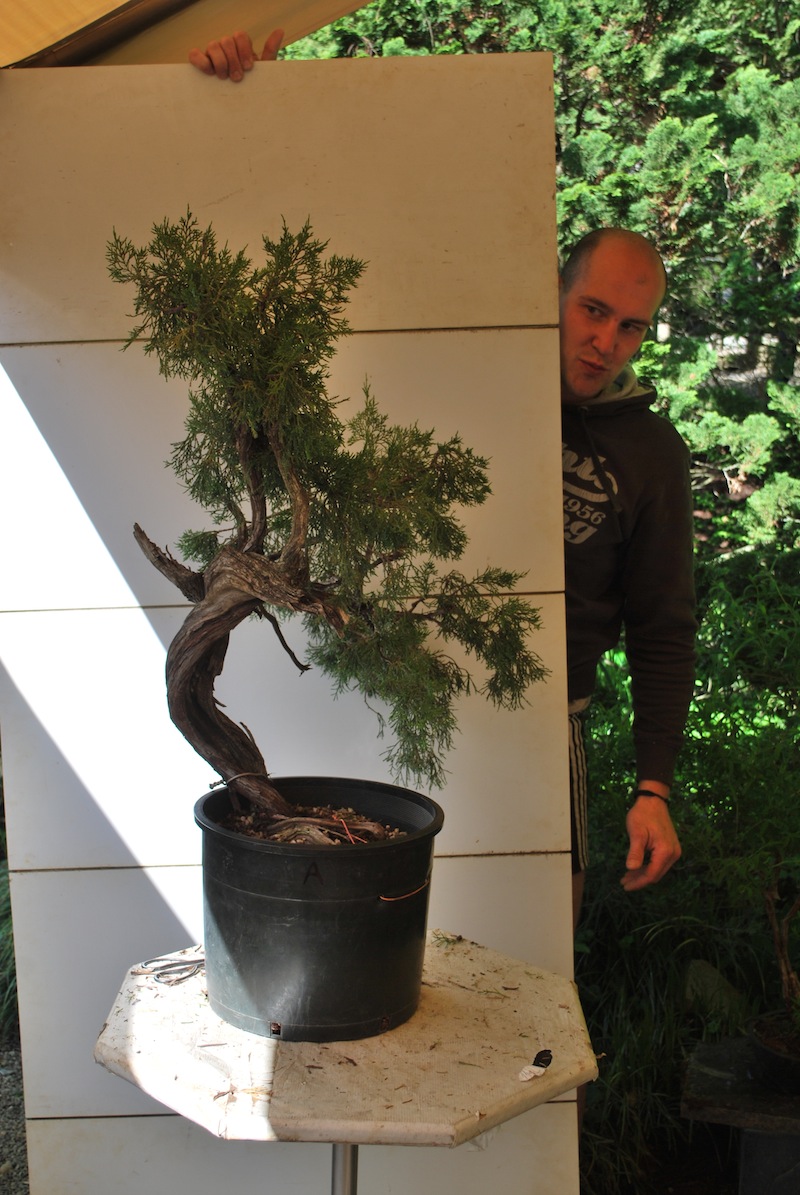
Here is the tree before starting. It is probably around 250 years. As you can see Mauro thinks it is a sweet piece!

He studied the tree, and made several sketches, showing styling options.


Option A was chosen, as it shows the dynamics within the tree quite well.


The top-most branch would have to go, and the bottom  right foliage mass would be raised a bit and brought forward to make a compact design.


Mauro proceeded to remove the top-most branch, and set it up as a jin.


In the process a nice hollow was discovered where the main trunk changes direction, so this was hollowed out to add an interest point.

The main branch had a lot of deadwood where the live vein was growing, so to do the work necessary on the branch, the live vein was split away from the deadwood. The deadwood was left as an interest point.

Some additional carving work was needed to free the live vein so it could be moved.

Note Mauro's concentration on the job at hand!

Finally the branch and deadwood could be separated.

A small amount of fine detail cleanup work was needed.

The live vein was then supported with several #6 gauge wires, and raffia was wrapped over the area which would be bent, to help spreading out the bending tension in the wood fibers. This prevents breakage in the living wood.


Next some black plastic tape was added, which will help keep the whole bend "under wraps" until it has time to heal over and grow into the new position into which Mauro would place it.
Here you can clearly see the supporting wires.
Heavy copper wire was then applied over the trunk and the bend area on the branch. Using several guy wires to hold it in position, Mauro carefully bent the branch forward, and slightly up.

The owner of the tree volunteered to help with the fine wiring on the branches. Once this was completed, the branches were placed into their final positions.

Both Mauro and Flex seem very happy with the result!

The tree will now rest for a year, and grow into it's new design. Meanwhile an appropriate pot can be found or designed.

Flex


Saturday, April 7, 2012

Eastern Redbud Doing It's Thing!


Here is an Eastern Redbud in my village. Had to grab some pix because have never seen one blooming this dense.
Almost makes you think it is artificial!
Flex

Sunday, April 1, 2012

Woodstock V: Repotting A Very Old Ponderosa

Woodstock V was held in Harrisburg the weekend of 30-31 March-1-April. The Friday session was sunny and warm, so we were all glad to be outside working in the warm Spring sun.
As usual, Walter Pall had the group work on his collected trees (which one could purchase...of course!). The focus was on good techniques for repotting.

Walter pulled in an old "Lurker" to assist with the various tasks...

The group took a break in early afternoon to repot one of the oldest trees in the nursery: a very old Ponderosa Pine, collected by Randy Knight a number of years ago. The Pine has been in the nursery for at least 5 years, and has filled in nicely, thanks to the TLC given by Jim Doyle and his crew.

Here is the pine before repotting was started. The tree was carefully coaxed from it's pot. Walter oversaw the whole operation, to make sure nothing was done to detract from the health of this old Pine.
The Pine was moved to a worktable so the rootball could observed. What a rootmass!
The health of this tree is quite remarkable, which just goes to show that with the right care and feeding one can improve on what Nature has to offer in the wild!

So back in the rootball...there was a lot of substrate which needed to be removed so that the ree could be repotted into a smaller pot. The health of the roots is remarkable; there are hundreds of white root tips showing.


Walter was obviously pleased with the progress of the work, and the quality of the Pine.


The flare of the old nebari at soil surface required some minor modification to fit it to the pot, so a Sawzall handled the task quickly. This would in no way harm the tree or detract from the quality of the material.


The group assisted in excess substrate removal, and the roots were kept moist by spraying with water.


The tree was then checked for fit in the new smaller pot...


I asked Walter if he would pose with the tree as he frequently does on his own blog...and he was happy to oblige!


If I could read lips, Walters' comment might be "SWEET!"


Finally the tree was mounted in it's new home. Substrate was added, and some additional care was taken with a set of roots which needed to be redirected downward into the soil.


Overall a major success.


Now the tree will recover from repotting this year, and we will see what is in store for this Old Pine.


...and here is the whole crew...smiling for a job well done on "The Buffalo"!

Flex

BTW...Walter has also posted pix of this wonderful tree and the repotting on his Travelogues site under the Woodstock V postings:

http://walter-pall-travelogues.blogspot.de/2012/04/woodstock-v-1.html


Sunday, March 18, 2012

Ryan Neil: 3-Days at Natures Way March 2K12


We spent 3 action-packed days with Ryan Neil. Focus was on species-specific information, with morning lectures and afternoon work.
Had the chance to work on some world-class material, as you can see from the photos (which are just a small fraction of the pix taken!).
Friday was a focus on Pines.
Saturday the focus was on Junipers.

We had the opportunity to clean up this very old Rocky Mountain Juniper, collected by Randy Knight. The covered deadwood was cleaned of any remaining bark. The exposed deadwood was hosed and thoroughly scrubbed, to remove all dirt, prior to lime sulphur application.
Ryan showed us several tricks for getting the most out of the lime sulphur treatment.
Here is the tree, post-lime sulphur. Ryan seems happy with the result...we did good!


The deadwood on this RMJ is world-class, so needs to be treated with the utmost respect.


On Sunday we discussed and worked on other conifers, including Taxus Yew, and Spruce.

One of the other members of Ryan's Mirai East group had a very old Colorado Blue Spruce, which needed touchup with it's styling to raise the level of quality. These changes required some major branch bending.
Here is the tree prior to any work.


Ryan and the owner agreed on the details of the work to be done, and Ryan went to work.


During work constant monitoring was necessary in certain areas of the tree where bending stresses could result in irrepairable damage.
Ryan and Jim Doyle checking...


Ryan cleaning up some wire bits...


And the finished work...what a jaw-dropper tree!

Ryan will be back out to help the study group in the Fall...can't wait!

Flex

Sunday, February 26, 2012

Feb 2K12 Workshop: Unintended Consequences Result in Giggles!

We had a nice turnout at the Feb BSSJ workshop...lots of folks carving, and many onlookers learning what carving was all about.

I brought in an old Acer Campestre (Field Maple) which had been carved out about 6 years ago, in a workshop with Graham Potter (UK).

Here is the tree just before Graham got started...


...and Graham getting into the large side branch with a Makita and one of his larger carving bits...

The Maple continued to grow out some small side branches, but the main roots and most of the trunk died back...


My plan for this Spring was to do some additional work on the existing deadwood, pull out the punky deadwood near the soil line, and change the planting angle.

The new design was to lay the whole tree over, so it looked like it had been ravaged by a hurricane, which ripped it apart and laid it over.

The vast amount of deadwood, positioned under the live tree, would make a very convincing survival story. I just had to carve out quite a lot of the old stuff to allow enough room to lay it over.
So...carving went into full throttle. Wood bits flew, I layered my clothing in punky wood dust, and finally took a break to work with several other folks who had questions.

One BSSJ member came running over and told me he heard a --THUD-- on the table, and there lay the deadwood I spent the morning carving!
Apparently all the vibration had loosened the deadwood from the live vein enough that it finally just fell away!


Talk about laughing! What a hoot it was...the joke was completely on me!


So...How to proceed?

Well...the plan is STILL THE SAME! I want to treat the break-away deadwood with preservative, connect it back with the live wood using mechanical means, and proceed with laying the whole design over like the 'Hurricane Maple' originally proposed. Should be a fun project, and in some ways, is like a 'Phoenix Graft', where the mating surfaces have been properly prepared.

I will report as progress is made.

Flex

Friday, December 23, 2011

All is Calm.....


To all Bonsai Folks, Throughout the World...

May your burdens be lifted, if just for One Magical Night, when He is Born....

Merry & Happy Christmas....
Flex

Saturday, December 3, 2011

Progressions: Korean Hornbeam #1


Here is a chunky Korean Hornbeam, purchased at Bonsai West in summer of 2005. The tree had several faults, which can be seen in the first few shots.

There is a large root at the left side which was chopped when the tree was collected. There is also a hole through the cross-over branches on the lower right, which was considered a 'fault'.
Both items contributed to the original low cost of this material.


The tree was left to grow for a year, then discussed at the Colin Lewis HoYoku school in Shady Side Maryland.


A nice European pot had been purchased in the previous September while visiting the Ginko Festival in Ghent Belgium. The Hornbeam seemed like it was ready for a better pot, so it was fitted to its' new home.

Here it is, in July of 2K6, at a private Bonsai Show in Shady Side Maryland. The tree had settled in nicely, and was healthy, but needed ramification, and styling of the foliage pads.

In the Fall of 2K7, the tree was critiqued by Peter Adams while on a visit to Natures Way.
Peter put together some good sketches, showing how the foliage pads could be set up, and what the tree might look like in the future.


He suggested a nice design for a simple blue pot, which would go well with the tree, and make a much better composition.

Hornbeams put on a wonderful show in the Fall, and this tree certainly delivered. Here it is in full Fall color in 2K7.

The pot was commissioned through Bryan Albright, and was received in Winter of 2K8.


The Hornbeam had filled out a bit over the growing season, so it was exhibited at the Philly Flower Show in Spring of 2K9. Work had started on the 'faults', and the large root at the back left had been removed. The area where it was cut was carved so it resembled an old rotted root area.


In April of 2K9, it was fitted to the new Albright pot. Peter Adams was spot on! The composition was quite striking!


Of course, the branch structure still had a long way to go, and major ramification was still needed.

The tree made it to Natures Way Open House in the Spring of 2K9. Here it is in wonderful Spring leaf.

It still has a way to go to fill in the foliage pads and increase ramification, and the styling Peter Adams suggested must continue.


Here is the tree in the Fall of 2K9,


and in the Fall of 2K11. You can easily see the branch growth and increase in ramification.


The tree is maturing into the style set for it, and will continue to mature and ramify. There is probably another 5-8 years of work needed to get it to the point where the tree is as twiggy as it needs to be, but it will certainly be fun traveling that road.

The additional benefit of all that twigginess (for which Korean Hornbeams are noted) is the additional reduction in leaf size.

Flex